The Arkansas Trav'ler
Pitmaster Gazette · Championship BBQ Edition
How-To Guide
A great bbq rub for brisket is almost shockingly simple — and if you’re coming from pork shoulder or ribs, that simplicity is going to feel wrong at first. Where pork rubs are layered with sugar and paprika and chili and cumin, the legendary Texas brisket rub is just salt and pepper. Equal parts. Nothing else. They call it the Dalmatian rub because it looks like a Dalmatian’s coat — black pepper spots on a white salt background.
And that simple rub, cooked on a good brisket for 12-14 hours, produces some of the best barbecue in the world.
But the salt-and-pepper-only school isn’t the only approach. Plenty of excellent pitmasters — including Jim Quessenberry — added other ingredients to their brisket rubs for specific reasons. Here’s the full picture of brisket rubs: the traditional Texas approach, when to step beyond it, what each additional ingredient does, and how to apply any brisket rub the right way.
Why brisket is different from pork
Before we get to the rub, you need to understand why brisket demands a different approach than pork shoulder or ribs.
Brisket is beef. Beef has a different fat profile, different connective tissue structure, and a different natural flavor than pork. What brisket wants from seasoning is:
- Salt — enough to penetrate the thick cut and season the meat all the way through
- Pepper — coarse, aromatic, assertive
- Beef flavor emphasis — nothing that distracts from the natural beef
- Bark builder — but bark on brisket comes from the fat rendering and the surface drying, not from sugar
The three ingredients that define a pork rub — brown sugar, paprika, and chili — are not required on brisket. In fact, traditional central Texas pitmasters will tell you they’re actively bad for brisket because:
- Sugar burns during a 12-14 hour cook and can turn bitter
- Paprika adds a red color that masks the natural brisket bark
- Chili powder adds a Tex-Mex flavor that distracts from the beefiness
That’s the purist argument. Whether you buy it is a matter of taste.
The Dalmatian rub: the Texas standard
Ingredients:
- 1/2 cup coarse kosher salt (Diamond Crystal or Morton’s)
- 1/2 cup coarsely cracked black pepper (16 mesh if you can find it — that’s the restaurant-supply grind)
That’s it. Mix them together in a jar. Store them on the counter. Use on everything beef — brisket, prime rib, ribeye, beef ribs, tri-tip.
The famous Texas joints — Franklin Barbecue in Austin, Snow’s BBQ in Lexington, Louie Mueller Barbecue in Taylor, Kreuz Market in Lockhart — all use essentially this exact rub, with occasional minor tweaks like a pinch of garlic powder or MSG.
Why it works:
- The salt penetrates deep into the brisket and seasons the meat all the way through
- The coarse pepper creates a peppercrusted bark that’s one of the signature textures of great brisket
- There’s nothing to burn, nothing to distract, nothing to hide weaknesses in the meat
What mesh size is black pepper? Most store-bought “coarse” black pepper is actually about 28 mesh — which is closer to table grind than true coarse. For a Dalmatian rub you want 16 mesh, which you can buy from restaurant supply stores or online from spice specialists. The difference is significant. 16 mesh pepper holds up through the cook and creates a textured crust; 28 mesh pepper disappears into the meat.
When to add more than salt and pepper
The purist Dalmatian approach is great, but there are legitimate reasons to add more. Here’s what each common addition does:
Garlic powder
Adds: savory depth, a background umami note Typical amount: 1 tablespoon per 1/2 cup of salt + pepper base Why you might use it: garlic powder integrates well with beef and adds complexity without fighting the meat. Many Texas pitmasters add it and won’t admit it.
Onion powder
Adds: sweet-savory background note Typical amount: 1 tablespoon per 1/2 cup base Why you might use it: same reason as garlic powder — rounds out the rub. Don’t go overboard.
Paprika
Adds: red color, mild pepper flavor Typical amount: 1 tablespoon per 1/2 cup base Why you might use it: if you want a more mahogany-colored bark instead of the classic dark-pepper Texas look. Not traditional but not wrong.
Brown sugar
Adds: sweetness, caramelization Typical amount: 1 tablespoon per 1/2 cup base Why you might use it: if you prefer a slightly sweeter bark and you’re cooking at 225°F or below where sugar won’t burn. Some Memphis-style pitmasters add a touch of brown sugar to brisket. Central Texas never does.
Chili powder
Adds: Tex-Mex warm spice profile Typical amount: 1 teaspoon per 1/2 cup base (use sparingly) Why you might use it: for a southwestern Texas / border-style brisket. Not right for central Texas.
Coffee grounds
Adds: earthy depth, a bitter note that plays well with beef Typical amount: 1 tablespoon of fine-ground espresso per 1/2 cup base Why you might use it: coffee and beef are a proven pairing. It’s unusual but not unheard of on competition tables.
Cayenne
Adds: heat Typical amount: 1/2 teaspoon per 1/2 cup base Why you might use it: if you want a background tingle without making it a “spicy” rub.
A Jim Quessenberry brisket rub
Jim was an Arkansas pitmaster who cooked more pork than beef — but he cooked plenty of brisket too, and his style was never pure Texas. Here’s how we’d build a brisket rub in his tradition:
- 3 tablespoons coarse kosher salt
- 3 tablespoons coarse black pepper (16 mesh if you have it)
- 1 tablespoon garlic powder
- 1 tablespoon onion powder
- 1 teaspoon paprika (for a touch of color)
- 1/2 teaspoon cayenne (for a background warmth)
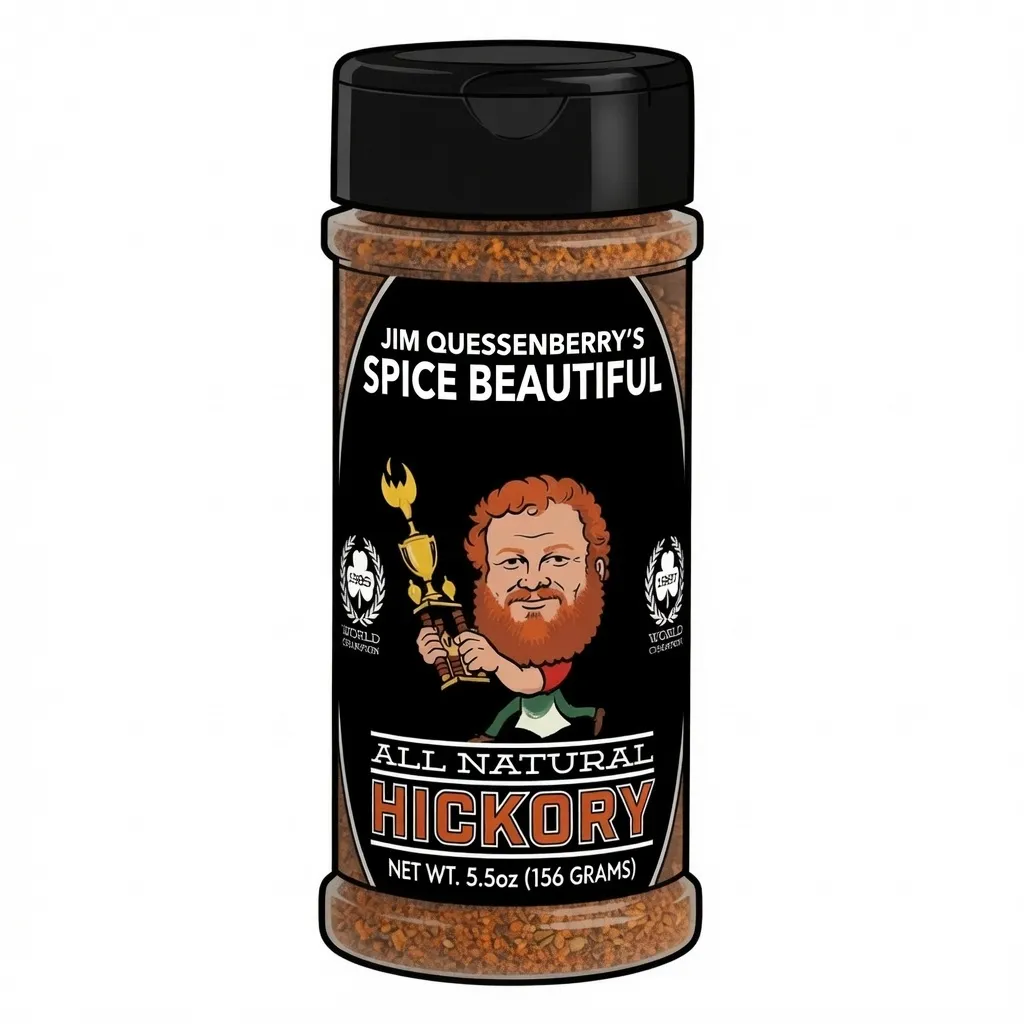
This is about 75% Dalmatian with a supporting cast. It still lets the beef be the star, but it adds a little Arkansas roundness to the flavor. Spice Beautiful Hickory is not specifically a brisket rub — it’s tuned for ribs — but it’s close enough to this profile that you can use it on brisket in a pinch.
How brisket rub differs from rib rub
Side-by-side:
| Feature | Rib rub | Brisket rub |
|---|---|---|
| Brown sugar | Yes, lots (1/2 cup typical) | No, or very little |
| Paprika | Yes, lots (1/4 cup typical) | Optional, small amount |
| Chili powder | Yes | No (in Texas) |
| Cumin | Yes | Rarely |
| Mustard powder | Yes | Rarely |
| Black pepper | Medium | Lots (at least 1:1 with salt) |
| Salt | Moderate | Heavy — brisket penetration requires it |
| Grind | Medium-fine is fine | Coarse — 16 mesh pepper is ideal |
The short version: rib rubs are layered and sweet; brisket rubs are simple and pepper-forward. If you try to use your favorite rib rub on brisket, it’ll be edible, but it won’t be right. It’ll be a Tex-Mex-leaning brisket that doesn’t quite taste like what brisket is supposed to taste like.
For the rib side of the comparison, see our rib rub guide or our pulled pork rub guide.
How to apply brisket rub
-
Trim the brisket first. A brisket comes with a heavy fat cap. Trim it to about 1/4 inch thick on the top — enough to render and baste the meat, not so thick that the rub sits on fat instead of meat. Trim away any hard deckle fat on the edges.
-
Pat the trimmed brisket dry with paper towels.
-
Apply a thin binder. For brisket, a lot of pitmasters use Worcestershire sauce or hot sauce as a binder instead of mustard — they integrate better with beef. Brush it on thin.
-
Apply the rub from about 10 inches above the meat. Sprinkle, don’t dump. Cover the top completely. Hit all four sides. Flip and hit the bottom. On a 12-pound brisket, you want roughly 3/4 cup of rub total.
-
Don’t pack it down. Let the rub sit on the surface. As the moisture from the binder activates the rub, it’ll naturally adhere.
-
Rest in the fridge for 2-12 hours. Brisket benefits from a long rest, just like pork shoulder. Overnight in the fridge lets the salt dry-brine the meat for better penetration.
-
Pull from the fridge 45 minutes before the cook. Let it come up toward room temperature. A cold brisket going straight onto a 225°F smoker takes much longer to hit the stall.
The bark that’s actually possible
A properly rubbed brisket, cooked at 225°F for 12-14 hours, can produce bark that’s almost black — dense, peppery, slightly crunchy, concentrated with beef and smoke. That’s the championship look. It comes from:
- Enough pepper on the exterior to form a textured crust
- Enough salt to penetrate and season throughout
- Enough fat in the surface to render and baste the bark as the cook proceeds
- Enough time for the Maillard reaction to fully develop
No amount of sauce will cover up a weak bark. Brisket sauce is a finishing condiment at best — and in central Texas, brisket sauce is barely used at all. The rub does 90% of the work.
What you need
- Spice Beautiful Hickory — the hickory rub, in a shaker. Closest to a Texas brisket profile of anything in the lineup
- Sauce Beautiful Original — if you want a finishing sauce on the side (we won’t tell the Texans)
- Pick 3 Combo — the rub, sauce, and one more at a discount
Cook that sumbitch. We’ll eat it.
— End of dispatch · Shipped by Jim's sons —